16 December, 2012

Memories of Tuscany

I am lucky that I had the chance to enjoy the beauties of Tuscany. I lived in Florence for a year (2006-2007), and during that time I visited Pisa, Chianciano, Fiesole, Arezzo, Tavarnelle in Val di Pesa, Prato, Lucca... and I fell in love with Siena.

I will start with Florence, since I lived there and it is the place I am most acquainted with. It is a beautiful city. A smelly, old, dirty, unfriendly, beautiful city. It lives from it's old glory, that is the numerous monuments, palaces, churches, squares, and streets, so that the new things being built are on the outskirts of the city, and are just plain, normal buildings. The main university has been transferred from the center to the periphery of the city, but with not much success since at night the part is known to be a gathering place for prostitutes. Ok, this was a fact at the time I used to live there, which is five years ago, so I hope it has changed during these last years. However, Florence is situated in a valley, so there are very few higher points to climb. My personal favorite was Piazzale Michelangelo. I adored that they organized concerts on that piazza, with the view of the whole city.


However, being in a valley, Florence in summer is hot. And not normal hot, but HOT hot! There is no breeze, just damp hot stinky air. I keep emphasizing stinky and smelly because the whole city is consisted of narrow streets, which during the night get peed on in large quantities, so during the day wherever you go you sense the smell of piss. That during summer is even more emphasized.


Besides Piazzale Michelangelo, my favorite place in Florence was Piazza Santa Croce. The large empty (only on occasions filled with bancarelle) piazza in front of the beautiful church has always given me a sense of serenity, which I can not explain. The church is very famous also because inside are the tombs of famous persons like Michelangelo, Galileo, Ugo Foscolo, Vittorio Alfieri etc. However, for me, the inside of the church was not something I enjoyed. In fact, I visited the church only once, also due to the fact that there is a ticket you have to pay to get inside.

The third place I thoroughly enjoyed was, of course, Piazza della Signoria, and especially the Loggia, where I used to sit for hours and just look at the people, or listen to the music the street artists would play, or laugh at the jokes the street clown would do to the passers-tourists. One time, me and my friend were lucky enough to meet an elderly Florentine man who told us hundreds of stories about the city. He took us to a private tour and showed us some of the hidden gems you don't usually get to see with the guided tours, or you don't notice by yourself. He showed us the hidden face of the artist on the back of one of the sculptures of the Loggia, the carved face in the wall of the Palazzo Vecchio, said to be made by Michelangelo himself while watching a public execution. He took us to see The Olive Tree of Peace planted at the place where a bomb exploded in '93 near the Uffizi Gallery, places with remains of the big flood (1966), etc.

Another place I often went with my friends was the terrace of La Rinascente, overlooking Piazza della Repubblica. Beside the fact that the coffee was exquisite, the view, especially when there was sun, was beautiful. Even though the coffee costs more than anywhere else, it is well worth it.

One obvious building that has to be mentioned when speaking about Florence is the Duomo (Santa Maria del Fiore) which is one of the biggest churches in the world (5th biggest in Italy, after 2 in Rome, Milan and Padova). It occupies the central place of the city, and its vastness is really breathtaking.

Another symbolic place not to be missed if you are one of thise tourists who roam a city looking for places from postcards is Ponte Vecchio. The "old bridge" (literal translation) was built to connect Palazzo Vecchio and Palazzo Pitti, which is on the other side of the river and together with the Boboli gardens is well worth a visit.

The other side of Arno is where young locals gather at night, mostly in Piazza Santo Spirito, but also everywhere around in the old narrow streets.

View of Florence with Ponte Vecchio from Piazzale Michelangelo
Florence is believed to be one of the cities with most art in the world, so it has tourists almost all of the year. While it is a good thing for the city, it is not such a good thing for the people who live there. It used to take me 40 minutes to get from the Duomo to my appartment (which was on Piazza Sant'Ambrogio), a distance I could pass in 20 minutes when the streets were empty. I think that it is the main reason why i Fiorentini are so unfriendly. They are literally the most unfriendly people I have ever met! And they are rarely to be found IN the city, because they go to places that aren't visited by tourists, bars and clubs that only they know. It happened more than once that someone was really rude if I asked something, like direction or the time. Oh, and they speak the most uncomprehending Italian in all of Italy! Words like Hoha-Hola (Coca-Cola) and Hasa (casa) remained a recurrent joke when speaking about Florence. I must say that all of this was a major throwback the first month I arrived in Florence. But, after a while I got used to it, and didn't really pay much attention.

Siena
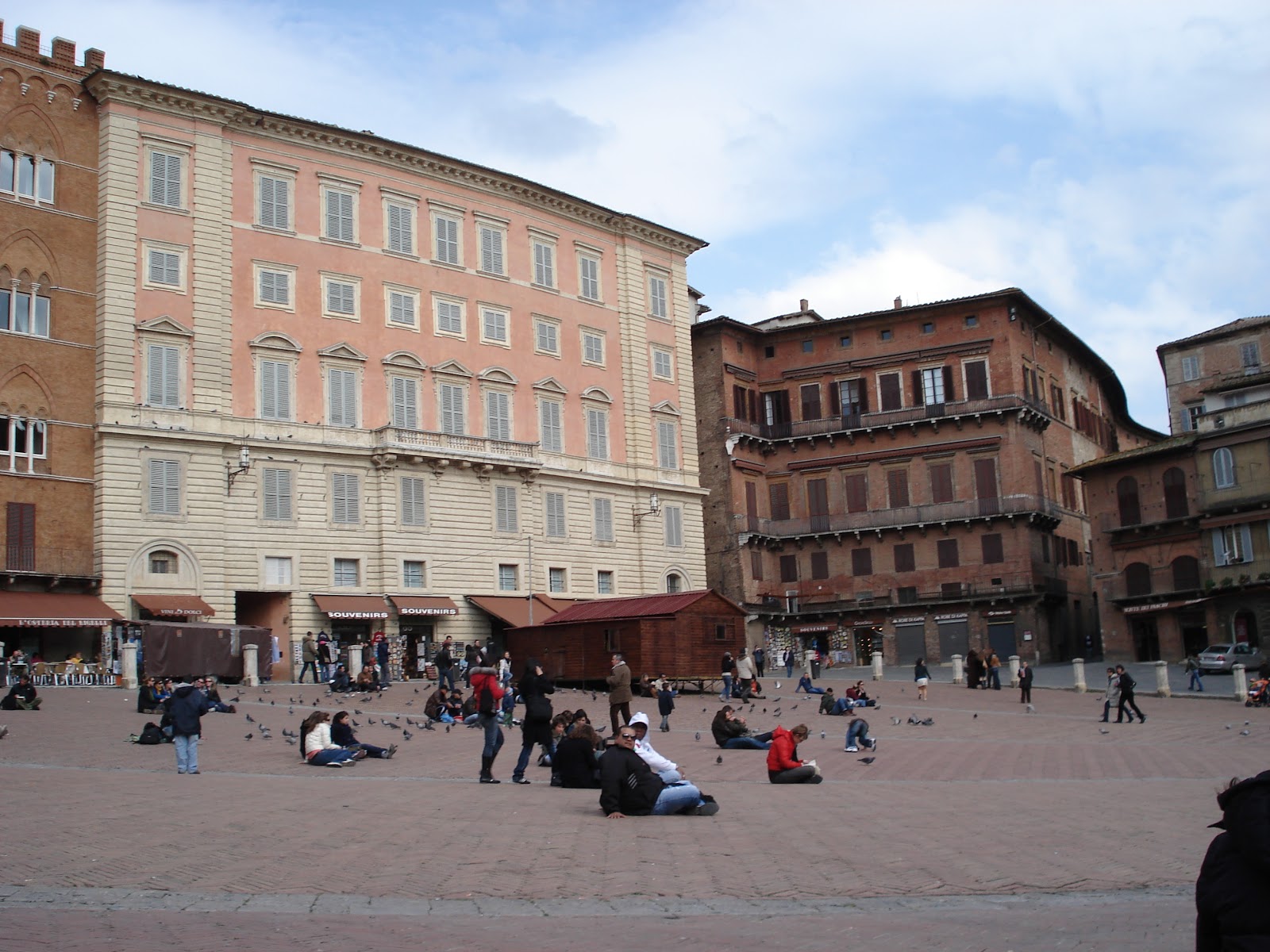
While Florence is the most famous city in Tuscany, Siena was the true gem for me. It is a BEAUTIFUL city. Not crowded, more laid back, but with all the important historical sites and structures. I used to go there often just to get away from the crowds, relax on the main Piazza, walk around in the streets, go up to the Duomo, and just enjoy the views of the city. Naturally, Siena is also cheaper than Florence, which is another advantage.

Siena's main square
Another small city I thoroughly enjoyed visiting was Lucca. Its center is surrounded by a wall that was built to protect the city, and now it is a limit to the city center, where you can walk for hours and discover small streets, shops and cafés. As in all Italian cities, the main square has its big church, and the stairs where you can sit and relax.

Arezzo is also a town in Tuscany well worth visiting. It is the setting of the film La vita è bella by Roberto Benigni, and everywhere around the town there are signs that show which scene was shot there. If you are into poetry and have read Renaissance poets, you can visit the house where Petrarca was born in Arezzo.     

Chianciano (photo by Elisa Correa)
Finally, you can't say you really visited Tuscany if you haven't been in the smallest villages in the vast beautiful fields and hills, almost deserted and centuries old. Centuries old can also be said about some of the inhabitants you might encounter there.. I guess slow food and fresh air really do make a difference. 

19 November, 2012

Madame Bovary


I just finished reading the book. Why on earth did I wait until now - I don't know. However, here are my favorite parts from "Madame Bovary":

(Part 2, Chapter I) The chemist answered: "I have a religion, my religion, and I even have more than all these others with their mummeries and their juggling. I adore God, on the contrary. I believe in the Supreme Being, in a Creator, whatever he may be. I care little who has placed us here below to fulfil our duties as citizens and fathers of families; but I don't need to go to church to kiss silver plates, and fatten, out of my pocket, a lot of good-for-nothings who live better than we do. For one can know Him as well in a wood, in a field, or even contemplating the eternal vault like the ancients. My God! Mine is the God of Socrates, of Franklin, of Voltaire, and of Beranger! I am for the profession of faith of the 'Savoyard Vicar,' and the immortal principles of '89! And I can't admit of an old boy of a God who takes walks in his garden with a cane in his hand, who lodges his friends in the belly of whales, dies uttering a cry, and rises again at the end of three days; things absurd in themselves, and completely opposed, moreover, to all physical laws, which prove to us, by the way, that priests have always wallowed in turpid ignorance, in which they would fain engulf the people with them."

(Part 2, Chapter IV) … Her husband, was he not something belonging to her? As to Emma, she did not ask herself whether she loved. Love, she thought, must come suddenly, with great outbursts and lightnings--a hurricane of the skies, which falls upon life, revolutionises it, roots up the will like a leaf, and sweeps the whole heart into the abyss. She did not know that on the terrace of houses it makes lakes when the pipes are choked, and she would thus have remained in her security when she suddenly discovered a rent in the wall of it.

(Part 2, Chapter VII) The flames, however, subsided, either because the supply had exhausted itself, or because it had been piled up too much. Love, little by little, was quelled by absence; regret stifled beneath habit; and this incendiary light that had empurpled her pale sky was overspread and faded by degrees. In the supineness of her conscience she even took her repugnance towards her husband for aspirations towards her lover, the burning of hate for the warmth of tenderness; but as the tempest still raged, and as passion burnt itself down to the very cinders, and no help came, no sun rose, there was night on all sides, and she was lost in the terrible cold that pierced her.

(Part 2, Chapter X) But she was so pretty. He had possessed so few women of such ingenuousness. This love without debauchery was a new experience for him, and, drawing him out of his lazy habits, caressed at once his pride and his sensuality. Emma's enthusiasm, which his bourgeois good sense disdained, seemed to him in his heart of hearts charming, since it was lavished on him. Then, sure of being loved, he no longer kept up appearances,
and insensibly his ways changed.
He had no longer, as formerly, words so gentle that they made her cry, nor passionate caresses that made her mad, so that their great love, which engrossed her life, seemed to lessen beneath her like the water of a stream absorbed into its channel, and she could see the bed of it. She would not believe it; she redoubled in tenderness, and Rodolphe concealed his indifference less and less.
She did not know if she regretted having yielded to him, or whether she did not wish, on the contrary, to enjoy him the more. The humiliation of feeling herself weak was turning to rancour, tempered by their voluptuous pleasures. It was not affection; it was like a continual seduction. He subjugated her; she almost feared him.

(Part 2, Chapter XII) He had so often heard these things said that they did not strike him as original. Emma was like all his mistresses; and the charm of novelty, gradually falling away like a garment, laid bare the eternal monotony of passion, that has always the same forms and the same language. He did not distinguish, this man of so much experience, the difference of sentiment beneath the sameness of expression. Because lips libertine and venal had murmured such words to him, he believed but little in the candour of hers; exaggerated speeches hiding mediocre affections must be discounted; as if the fullness of the soul did not sometimes overflow in the emptiest metaphors, since no one can ever give the exact measure of his needs, nor of his conceptions, nor of his sorrows; and since human speech is like a cracked tin kettle, on which we hammer out tunes to make bears dance when we long to move the stars.

(Part 3, Chapter VI) … Emma was no longer there. She had just gone in a fit of anger. She detested him now. This failing to keep their rendezvous seemed to her an insult, and she tried to rake up other reasons to separate herself from him. He was incapable of heroism, weak, banal, more spiritless than a woman, avaricious too, and cowardly.
Then, growing calmer, she at length discovered that she had, no doubt, calumniated him. But the disparaging of those we love always alienates us from them to some extent. We must not touch our idols; the gilt sticks to our fingers.

15 August, 2012

How I remember (and love) London

Watching the Olympics and all the marathons through London, I was reminded of why I still think London is one of the best cities in the world. Even though 4 years have passed since I left London, the memories are still vivid in my mind.

The first thing that comes to my mind when thinking about my time spent in London are the long walks I would take from one part of the city to another. My own personal marathons. Walking for hours and hours, going from one neighborhood to another, noticing the differences and the similarities between them. I used to walk from Notting Hill, across Hyde Park, passing Oxford Street, going to Piccadilly Circus, Leicester Square and Soho, finishing with a meal in Chinatown.
A view of Big Ben from Trafalgar Square
Or another route from Russel Square, all the way to Covent Garden, continuing to The Strand, then Trafalgar Square, Westminster, Westminster Bridge and then on the other side towards Tate Modern, one of my very favorite places in London. There were also long walks in Camden, Brick Lane, Chiswick, Hammersmith, Kensington... Sometimes alone, sometimes with my friends and sometimes with my then-boyfriend. Those beautiful days with plenty of sun... or the rainy days, with us under the umbrella. It was pure perfection.
Sometimes, the sunset would make everything even more perfect
By the second month I was there I had it all figured. The Saturdays were for Notting Hill and the Sundays for Brick Lane. I would eagerly wait for those weekends just to enjoy those wonderful markets! I have to admit I didn't buy much. I, being a well-known shopaholic, would be satisfied just by that atmosphere.
The colors of Notting Hill
Yes, London is expensive. Food is expensive, transport is pretty expensive, going out at night is ridiculously expensive, however the museums are free! Tate Modern, the British Museum, the National Gallery.. they are all free! Which is amazing!

Another thing that's amazing and free are the beautiful parks! My favorite was Regent's Park, however one should not miss St. James's Park, Hyde Park of course, and all the small gems throughout the city. I was really astonished of how they managed to have all those really well-maintained green spaces in every neighborhood.
St. James's Park
Another place I loved relaxing in (but not for free) were the pubs. I'd have a beer, mulled wine in winter, some snack or whatever. Alone, with a book, with a friend, or with a larger company. Sometimes I'd just have a conversation with a complete stranger, and it would all feel so familiar, so home-like.

Books are another thing I associate with London. I clearly remember people reading books everywhere. I admire their culture of reading and the variety of bookstores. I loved the small (and bigger) bookshops on Charing Cross with second-hand books hidden in the basement or in the attic looking older than the books themselves. (I hope they survived the economic crisis.)

In London, I loved going to the theater. Watching Kevin Spacey, Jeff Goldblum, Christian Slater, or singing along to the songs in the musicals was truly an extraordinary experience. So extraordinary that I could not afford it more often, since going to the theater costs a lot. However, I am happy with what I managed to see.

Finally, what I truly liked and could never forget about London was the politeness of the people. They always have some kind word, a smile, or an advice to offer you, even if you are not looking for it. I was stunned by people offering me help by themselves the first days when I was struggling with my map. Later I felt such pride when I was the one that could offer help to tourists!
Oh, I am so going to London again soon! :)     

08 August, 2012

When in Rome..

I've visited Rome in all seasons: in winter, in spring, in autumn, and this last time - in plain summer. Being the beginning of July, I was prepared for the heat, but one thing I wasn't prepared for was the humidity. It really felt like 100 degrees! Luckily, the Romans managed better with the heat than with the snow. When I was there in February, there was around 1 cm of snow and the whole city was literally paralyzed.

Since I had been there before I didn't need to visit all the tourist attractions, monuments, fountains etc. and that was such a relief. But it wasn't so easy for all the hoards of tourists, mainly American, that in 100 degrees Celsius sun would be brave enough to get on an open roof bus being driven around the city. Visiting Fontana di Trevi was a nightmare, at any hour of the day. I would literally just try to get away from all those people, completed with the annoying sellers of all kinds of stupid-things-no-one-would-buy! The Spanish Steps are always a little bit more relaxed because there is more space, however the annoying sellers there become even more annoying, throwing small glowing balls (I couldn't figure out what those balls were!) in the air ALL the time.

Anyhow, I should start from the beginning. My first "adventure" at the airport. My happiness of finally arriving, after the 6-hours trip from Skopje to Belgrade in the bus, was killed when I saw the line for passport control for non-EU citizens.With 3 transatlantic planes arriving at the same time and only two policemen working, I figured I'd be there in the next hour. I wanted to shout "Macedonia is IN Europe you scumbags! It's not in Africa!!!" But I didn't. I waited patiently.

Having gone through that, I decided I would take the bus to get to the city center, since it was the cheapest way (the train is 14 euro, the bus 4!). I bought the ticket, waiting for 5 minutes while the girl was talking on the phone explaining to her colleague how she flirted with the cute French guy who bought the ticket before me. I wasn't really in the mood to fight, so I just let her finish. Waited patiently again. The ticket bought, I went outside to find the bus that was supposed to leave in 10 minutes. Seeing a huge group of people waiting I knew that it was the place and that the bus was late. I tried to count how many people were there, but it was obvious to everyone there were TOO MANY! I stood in a strategic position, behind a guy who knew the woman from the company, who was standing there trying to make some order. When the bus arrived you can (or cannot) imagine the chaos, everyone trying to push their suitcase or bag in the bus, pushing people to get into the bus, while the woman was yelling "calm down, calm down"!! I successfully managed to put my luggage and find a place in the bus, and had to watch around 15 people outside being told just to wait for the next bus, who-knows-when! I felt sorry for those people, but in the same time I was proud of myself that I managed to act in Italian mode!

What unintentionally marked my trip to Rome was their win in the semi-finals of the European Championship against Germany. Seeing all the people on the streets celebrating, drinking, singing, yelling, breaking bottles, joking, laughing, chanting.. you would think they won the World Cup! It was the creation of this euphoria why their loss in the finals was so tragic. 100 000 people were gathered in Circo Massimo to watch the final.. and I didn't see (but I can clearly imagine) how they left it after they lost 4:0 from Spain.


I knew that the beaches around Rome are very crowded and not very nice, but with that weather the beach was inevitable. So, me and my friend decided to visit Ostia Antica, which is an archaeological spot on the way to the beach and then continue and just randomly choose where to go. I don't know what I'd expected from Ostia, but in that sun it might as well have been the Taj Mahal, I would only think of the beach and the water. A lot of ruins, a confused person at the entrance, no proper map or guide, a bunch of Americans, toilets with no toilet paper, a nice sandwich at the restaurant and we were good to go. Oh, and google-translated-signs:

We decided we would go to the last train station, hoping that the beach there would be less crowded, being further from the city. But, my eagerness and excitement was killed when we got close to the beach and we couldn't enter, because they were "private". I couldn't understand how can a person say that the sand or the water is their, and that you have to pay to "use" them!! We would not pay for something that is there for free so we decided we would look for a "spiaggia libera" (free beach). Luckily, we walked only for about 5 minutes and we saw the sign.. small, neglected, rusty sign. We immediately said we were going to the free beach, but the guy at the entrance would not let us in, instructing us to go up the stairs, pass the official entrance and explain there where we were going. I kept thinking how a tourist that doesn't speak Italian, would not menage with all that or would not want to be bothered and would simply pay. In the end, we got in, we found a nice spot and we enjoyed our day at the beach.

Another thing I truly enjoyed this time in Rome was Castel Sant'Angelo. I hadn't been there before and I always wanted to see it. It's really worth the money and the time. The view of Rome from there is spectacular. I'd recommend it to everyone!


With all that, the best part of the trip was spending time with my friends and eating some really really tasty food. I ate some great home-made meals, and I went to some amazing restaurants. However, it's definitely the common rule: always avoid the places where you can see more than 5 tourists!! :)        

29 April, 2012

La Pianiste

It's been a long time since I've watched a movie that inspired such strong emotions in me to be disgusted and intrigued at the same time. To be covering my eyes and wanting to scream "Nooo!!", but curiously expecting what will happen next.

Apart from the amazing music throughout the whole movie, the extraordinary performance by all of the actors, the artistic scenery and camera angles, there is Haneke's mastery. The mastery of knowing how to shoot the face expression, of how long to make a scene last, of when to cut the scene and leave us wondering.

Even though the movie is made according to the book "La Pianiste" by the Nobel laureate Elfriede Jellinek, in my opinion no other director would be able to make that transfer from paper to screen more convincingly.

The main theme the book and the movie explore is the domination-submission relation. All of the characters are dominating at one point of the movie and are then submissive in other circumstances. It captures perfectly the reactions of the characters. How does the other part behave and react when one is dominating and how when one is submissive. Isn't love a game of submission and domination? Aren't all relations we form during our lifetime in one manner just a reflection of our position of dominating or submitting? Isn't the most essential relation of the individual and the society a relation of submission on the part of the individual?

Erika is firstly oppressed by the society which condemns the individuals like her. That is, individuals that do not conform to the general rules of socially acceptable behavior. She has to act strict and righteous in order to conceal all of her frustrations, sexual and non-sexual.

Then, there is the relation with her mother. Jellinek said that the character is based on her mother, and I am sure she is a representation of many other mothers, who are dominant and submissive at the same time. One moment inducing pity and the next hatred.

Finally, the relation with her lover. Benoît Magimel is really wonderful to watch as he goes through all the different stages of submission-domination. First, the woman is domineering, setting all the rules and having the power to command the boy, who being in love and younger is immediately put in that position. But, what can the woman expect when expressing her most hidden secrets, when completely opening herself to the man she begins to love? Only to concede her position of dominance and become completely vulnerable and in the hands of the man who now knows "the real" her. The boy doesn't immediately assume the dominating position, or isn't immediately aware of the change in their relation. When he becomes aware he is completely changed. Makes you wonder if it's not the exact same thing that happens in every love relation. The role of persuader changes gradually, and it's only after that we notice it.

I love movies that tackle so many different levels of the relations we form between us and the changes they provoke in our characters. I don't really know how come I haven't seen this movie earlier, but then again, I'm glad I didn't.
   

Le piccole cose

I found this lovely poem by Stefano Benni in one folder with papers from university. 
The small things (of you that I love)

1. Le piccole cose
che amo di te
quel tuo sorriso
un po' lontano
il gesto lento della mano
con cui mi carezzi i capelli
e dici: vorrei
averli anch'io così belli
e io dico: caro
sei un po' matto
e a letto svegliarsi
col tuo respiro vicino
e sul comodino
il giornale della sera
la tua caffettiera
che canta, in cucina
l'odore di pipa
che fumi la mattina
il tuo profumo
un po' blasé
il tuo buffo gilet
le piccole cose
che amo di te

2. Quel tuo sorriso
strano
il gesto continuo della mano
con cui mi tocchi i capelli
e ripeti: vorrei
averli anch'io così belli
e io dico: caro
me l'hai già detto
e a letto
stare sveglia
sentendo il tuo respiro
un po' affannato
e sul comodino
il bicarbonato
la tua caffettiera
che sibila in cucina
l'odore di pipa
anche la mattina
il tuo profumo
un po' demodè
le piccole cose
che amo 
di te

3. Quel tuo sorriso
beota
la mania idiota
di tirarmi i capelli
e dici: vorrei
averli anch'io così belli
e ti dico: cretino
comprati un parrucchino!
e a letto stare sveglia
a sentirti russare
e sul comodino
un tuo calzino
e la tua caffettiera 
che è esplosa
finalmente, in cucina!
la pipa che impesta
fin dalla mattina
il tuo profumo
di scimpanzé
quell'orrendo gilet
le piccole cose
che amo
di te.  

01 March, 2012

Water Serpent


Someone once told me that I looked like the girl in this painting while asleep.

It is still the most beautiful thing that anyone has ever told me.

I used to love that person.

I am now sure I fell in love with his words.

Now and then I still miss those words.

29 January, 2012

Like Crazy


I watched Like Crazy yesterday before I went to sleep. I thought it would just be another chick-flick and I would fall asleep in the middle of the film. Oh, how wrong was I!

It was one of those real-and-depressing movies that would just make you wonder about your life, relationships, and attitudes.

In short, it's a story about an American boy and an English girl that fall in love at university in LA. She violates her visa permit and once in England she isn't allowed to go back to America. So they must figure (or not) out what they would do to keep their love alive.


And that's where the trouble begins. They were happy together, they had some unforgettable memories, but are they real? First she was a student abroad, then he came to visit her on vacation in England.. and rightfully said he didn't feel a part of her life, like he was on vacation.

The question being tackled here is whether this kind of relationships can really work in the "real" everyday life. Surely, one can't be the same while on vacation and at home, having everyday problems, errands, and troubles. One can not be carefree all the time. That's what really screws us up. We live in those happy careless memories once lived with a person we cared about, we obsess with them expecting them to happen again, while remaining ignorant to the fact that people change, and that it would never be like that again. While living and reliving those moments in our head we neglect the persons that are by our side, just for the fact that they will never be that perfect as the person in our head. And everything IS more beautiful in our head.

The ending is always the most difficult part in this kind of movies. The director chose to leave this one open. We see just a hint of what might happen, but then we are left to make our own ending. Optimists would say that they'll stay together, they will overcome all the problems, see a professional help if needed (I read that in one forum, would have never came to my mind) etc. The pessimists (like me) would say that they grew apart, that once the idea of actually being together has become reality, they figured they grew apart, they were different persons now, that too much has happened in between for them to be careless and happy as they once were, etc.

It's really depressing, but then again, it's reality. Real love and passion rarely endures all life. Or maybe I'm just a pessimist..

I read this great interview with the director. It explains a lot of the natural feeling of the movie.

28 December, 2011

Norwegian Wood

I am not a big fan of Murakami. It's not that I don't like him. On the contrary, I think his books are very readable. Every time I come across one of his books I gladly read it. But, there is nothing that would push me to the library to buy one of his books. I never put him in any of my lists of favorite books and I am not one of those people who wait impatiently for his next novel.

The main reason for this is that for me his books are quite forgettable. There is not a character, or a feeling, or an event that would linger after I finish the book. I read Norwegian Wood maybe 2 months ago and I can't recall anything, only the main atmosphere of the book, which as in most of his books is depressing and quite dark. It is a "love novel", but strangely, that love hasn't remained with me.
I have to return the book to my friend and I found that I had left bookmarks in two places. I find these excerpts quite true and well-composed. Here they are.

[...]Memory is a funny thing. When I was in the scene I hardly paid it any attention. I never stopped to think of it as something that would make a lasting impression, certainly never imagined that 18 years later I would recall it in such detail. I didn't give a damn about the scenery that day. I was thinking about myself. I was thinking about the beautiful girl walking next to me. I was thinking about the two of us together, and then about myself again. I was at that age, that time of life when every sight, every feeling, every thought came back, like a boomerang, to me. And worse, I was in love. Love with complications. Scenery was the last thing on my mind. 
Now, though, that meadow scene is the first thing that comes back to me. The smell of the grass, the faint chill of the wind, the line of the hills, the barking of a dog: these are the first things, and they come with absolute clarity. [...] And yet, as clear as the scene may be, no one is in it. No one.[...]

[...] "Hey, tell me, what do you think the best thing is about being rich?" [...] "Being able to say you don't have any money. Like, if I suggested to a school friend we do something she could say, 'Sorry, I don't have any money'. Which is something I could never say if the situation was reversed. If I said 'I don't have any money', it would really mean 'I don't have any money'. It's sad. Like, if a pretty girl says 'I look terrible today, I don't want to go out', that's ok, but if an ugly girl says the same thing people would laugh at her. That's what the world was like for me.[...]" 

14 October, 2011

Sagittarius

My Ascendant really defines me!

Sagittarius Ascendant from the Cosmo Natal Report:
"High-spirited, enthusiastic, and exuberant, you love adventure, change, exploring new territory, and are not happy confined to the same safe, familiar, secure little world all the time. You have a strong restlessness and yearning for something greater than anything you've yet experienced, and you often live in your dreams and visions for the future. You tend to believe that the grass is greener somewhere else and you like to keep moving, either literally or figuratively. Idealistic and optimistic, you always expect something better ahead. You love to have a goal, something to aim for, but once you achieve it you are on to something else. You are ever on the lookout for new opportunities and you are a gambler, willing to take risks and to break new ground. The possibility of discovering something new is what makes life interesting for you. You have great faith in life and bounce back quickly from disappointment and failure.

Freedom-loving and independent, you cannot tolerate being caged for very long, and friends and loved ones must respect your need for freedom of movement. Binding commitments and responsibilities often weigh heavily upon you and you may resist "growing up" and taking on the limitations of adult life.

You are friendly and outgoing and have a great sense of fun and playfulness. You are also philosophically minded and often quite outspoken about your convictions and beliefs. Sometimes you get carried away with your enthusiasm of the moment and you tend to exaggerate. You are often a big talker, full of big promises, and you are usually pretty convincing. You do everything in a big way, a generous way. You like to have the best, and you heartily dislike stinginess, littleness, or pettiness. Your vision is always large. You are able to perceive the big picture, general patterns and principles, and are well suited to politics, business, higher education or religion.

Other people see you as a good sport and a good friend, but one who is not always consistent and dependable. You may also be seen as a wise person since you do not get bogged down in pettiness and trivialities, and are able to communicate a larger way of looking at situations, one that opens up new potentials. You are a person who believes in miracles, grace, or just plain good luck, someone who never gives up on life, and you inspire and encourage others to keep looking forward."

From http://www.cafeastrology.com/sagittarius_ascendantrisingsign.html

05 August, 2011

MY BRAZIL II: Rio de Janeiro

Whatever you expect of Rio to be… it is not! It is not the immaculate beauty you see in the videos or in the photos. The sun does not always shine and all the faces are not smiling. The water is not always clear blue and the people on the beach are not all sexy and tanned. It’s not all these things but it’s more than that. The beauty of the nature is perfectly mixed with the flaws of the city structures. It is pretty much a normal city situated in a perfect surrounding. Rio is real!

That everything is not at all like in the photos you get to see immediately upon arriving when the plane approaches the airport and thus offering a magnificent view of the cidade. The beautiful coastline, the magnificent forest, the modern buildings… but also the small colorful packed houses of the favelas on every hill, guarding the city from above. That view is truly unforgettable! Santos Dumont airport is conveniently placed not far from the center, on a semi-island, giving you the impression you are landing in the ocean.

What I found very interesting is that later, in the bookshop, when I was looking at some books with photographs of Rio, in all the photos taken from above the photos were cut exactly at the place where there should be a favela. I never understood why! Seems that they are embarrassed of these slums, just ignoring them or avoiding them. For me, that is the real beauty of Rio.. the immediate contrast between rich and poor, between lovely houses and neighborhoods and favelas with small, badly made colorful houses (some even from cardboard).

Rio has undergone a big transformation through the years. It has been restructured to get a more strict, more organized form, which can clearly be seen on Rio Branco street, all lined with tall modern buildings that emit an atmosphere of not belonging in that laid back relaxed city.

Passing Rio Branco you immediately immerse in small crowded streets without any pattern or scheme. A couple of those streets form Saara, a neighborhood where you can find really cheap and low-quality goods, mostly of Chinese origins. Saara is very crowded during the day (it is not advised to go there during the night), but it is before Carnaval that it gets almost impossible to move there because everyone buys their wigs, hats, costumes and all the different accessories in Saara. I bought an afro-wig, oversized sunglasses, Minnie Mouse ears, glitter etc.

Bloco na Gloria
Being in Rio for the Carnaval you have to concentrate exclusively to that event, since all the shops are closed and the city becomes literally occupied by the blocos, playing carnival songs everywhere. It is really fun and exciting the first two days, but I have to admit it becomes annoying the third day. And it took a week for the city to come back to normal, meaning that shops and the museums were back to normal opening hours and the attractions resumed their primary place for the tourists.

Clearly, the first of those attractions is Cristo Redentor, or Corcovado, the statue of Christ overlooking the city from above. The view is spectacular, the crowds of people you have to struggle to take a photo of the Christ not so much. As with all symbols of cities they are always overcrowded and not a place you can spend more than half an hour. However, it is not very expensive (36 Reais, or around 16 Euros) so it’s well worth the visit.


The one thing Rio is proud of is its view from above, so you get many opportunities to go up and glance at the Cidade maravilhosa!

The second attraction after Corcovado is Pão de Açúcar (the Sugarloaf). It’s two hills connected with cable car and besides the view, which (in my opinion) is not as spectacular as from Corcovado, the really interesting thing is going up in the cable-car. For this enjoyment you’ll have to pay a little bit more: 45 Reais (or around 22 Euro). My friend told me people make parties up there and I’m sure they are really nice, considering the view and the surrounding.

Another place with a great view is Santa Teresa neighborhood. For the transport, the old bondinho (tram) is a must. It passes the Arcos da Lapa and going up you feel as if you’ve traveled in time. The neighborhood is not very well maintained, which is a pity since it’s one of the most authentic places, being a center for many artists, who have their art galleries and studios in all the unexpected places. I adored the shops with handicrafts and the walls painted with graffiti. An interesting spot to have a coffee with a great view of the city is the museum Museu das Ruínas, that is if you arrive on time (and not after 6 pm, like us). It is an old house where the socialite Dona Laurinda Santos Lobo held famous parties with guests like Villa-Lobos and Isadora Duncan.
The old bondinho in Santa Teresa
Very close to the bondinho stop in Lapa there is one unmissable place - Escadaria Selarón! The surrounding is a little bit shady, and going there by myself I felt a little bit uneasy. That feeling disappeared very soon. A woman saw me and invited me in a house, if I would like to buy some of the works from Selarón, who was sitting on the stairs and painting something (apparently pregnant women are his latest obsession). Speaking half-English and half-Portuguese they told me that the artist, who is Chilean, decorated the stairs to express his love for the city. I bought two small tiles and I got a free photo with him, which is definitely my favorite photo from the whole album! What a character! (Unfortunately, Selarón was found dead at this same place in 2013.)

Me and Selarón on the famous steps
To get a great view you can also go to one of the pacified favelas, like Santa Marta, right above Humaitá neighbourhood. They have installed a cable-car so you don’t have to climb all those stairs. What’s interesting about this favela is that Michael Jackson filmed his video for “They Don’t Care About Us” (here and in Salvador) and the spot where MJ danced in the video has become the main square of the slum. It was the first favela where the police entered and “liberated” it from the drug traffickers in 2008 so it’s pretty safe to walk around.

Michael Jackson's square in Santa Marta
One thing that really surprises me is the rising popularity of the favela tours. People pay a lot of money to go in the favelas with a guide that usually has an arrangement with the bosses of the favela. Obviously, the more popular ones are those not pacified, like Rocinha, the largest favela in Brasil and South America, which overlooks Leblon and Ipanema, the most exclusive neighborhoods in Rio. Beside the views, there is really nothing else you could see or do in a favela. Normal poor people, poor houses, sometimes no sewage or electricity... just real life, as it exists everywhere (without the stunning views).

Another interesting thing I did and I would recommend is going to Niterói (passing the magnificent but very full of traffic bridge) and glance at Rio from there. Cariocas have a saying (not very gentle) that the only thing worth seeing in Niterói is the view of Rio. It’s not quite true since there is also the extraordinary Museum of Modern Art designed by Oscar Niemeyer.

Having seen Rio from above, next are the wonderful parks. My first stop was Parque Lage, the beautiful setting from Snoop Dogg and Pharell’s “Beautiful”. It’s really a wonderful place to have a coffee and rest, or have a party at night. Then, there is Jardim Botânico, the botanical garden, where I felt as Alice in Wonderland among all the palm trees and walking on the small paths (unsuccessfully looking for monkeys). My friend also took me to Palácio do Catete, in the garden surrounding the old presidential palace (from when Rio was the capital of Brasil). The small park is nice and quiet, and I didn’t go inside the museum... Actually, the whole time I was in Rio I visited just one museum, Centro Cultural Banco do Brasil. I really didn’t feel like going to museums with all that beautiful nature.

Then there are the beaches. And they are beautiful beyond words. Copacabana is better for games and exercise because the stretch of sand is much larger, while Ipanema and Leblon are the beaches mostly visited by Cariocas. The first thing you should know when going to the beach in Rio is that the smaller the lower part of your bikini the better (cellulite and imperfections are very normal and no one seems to pay attention to those things) and never to take off the upper part of the bikini. Topless is forbidden and considered (oh the irony!) very vulgar. The second thing is that you shouldn’t take a towel to the beach unless you would like everyone to know you are a tourist. You should buy a kanga, sold literally everywhere. At first I was skeptical about not having a towel but then I realized that kangas are much more practical (sand doesn’t stick) and are easier to carry. However, the beach in Rio is not a place you would find peace and relaxation. People with all the possible things that can be sold at the beach cruise ALL the time. You are offered: açai,  camarão, bikinis, kangas, Globo-snacks, queijo, water, agua de coco, cerveja Atlantica, Guaranà, jewellery and everything else you can possibly imagine.

Copacabana
Rio's inhabitants, the Cariocas, are really relaxed, which is maybe a characteristic for all the people living by the sea. They wear their havaianas everywhere, cross the street wherever they want, drink really cold beer in small glasses and rarely arrive exactly on time. They, as all the Brazilians, are very passionate about football and the two main teams Flamengo and Fluminense. It was such a pity I couldn’t go to Maracanã (it was undergoing reconstruction works for the World Cup and the Olimpics), but I got to see the famous Fla-Flu derby at the second largest stadium – Engenhão, which, if the match hadn’t ended 0:0, would have been indeed spectacular.


With all this, the thing I enjoyed most was staying with my friends, experiencing their way of life, going with them to birthday parties and house parties (I'm so thankful they took me with them!), meeting new people, dancing samba with them, eating wonderful food, explaining where Macedonia is and how come I am there, inviting them all to come to Europe, hoping that some day I'll see them again... To all of them I can just say: Saudade enorme!

24 April, 2011

MY BRAZIL I: My São Paulo

Even without knowing the facts about the population and the dimensions of the city, you just need a glance through the window in the plane and everything will be clear. I had the luck to choose São Paulo as my first destination, and the view on the city from above is literally INDESCRIBABLE. An immense surface covered with concrete, intersected with snake-like roads. What is even more beyond words is the view and the feeling if you are landing or taking off at the airport Congonhas. When built the airport was situated outside the city but with the fast growth of Sampa it became an airport among buildings… and São Paulo is the third city in the world in number of buildings, the largest city in Brazil and second largest in Latin America with around 12 millions inhabitants. The heliopads on the top of the buildings are unmissable, since Sampa has the largest helicopter fleet in the world. And opposite of what is commonly presumed, the helicopters are not used because of the crime threat, but because of the traffic.

However, the view from above is not the only thing that would make you conscious about the vastness of São Paulo. It is a city where most of the population lives in the buildings, and where houses have become shops, designer show-rooms, cute craftsman’s spaces etc. There are some beautiful shops in the houses in Vila Madalena (one of the trendiest neighborhoods in Sampa) that seem like museums. Almost every building has a guard and huge fences, so if you want to go in you have to explain to the guard who you are because even the people who live in the building do not have the key to the front door. It is one thing that remained from the 90s, when São Paulo was a very dangerous city to live in. Today it is much safer, but still you have to know where to go and when and which places to avoid, a common practice in almost every big city. For example, the places you should avoid at night and where you should be careful even during the day in São Paulo are, sadly, the most beautiful and historic places, like Praça da Sé, the Pinacoteca, Estação da Luz etc. All around these places there are homeless people, drug addicts, crazy people.. it stinks and it’s dirty. I don’t know the reason, but it must be because the favelas in Sampa are outside the city, so these people just stay there not having the means to go to the outskirts of the city. It is such a pity!

Speaking of the places to see in São Paulo, there is one saying that São Paulo is famous for its ugliness as Rio is for its beauty. My impression did not confirm this. Rio’s beauty is undeniable, but more obvious, more commercialized, more on the outside. Sampa is beautiful on the inside, its beauty is more subtle and it is something you have to discover. São Paulo is beautiful for its vastness, for its diversity, for its offer of places and things to do, especially if you like discovering different restaurants, bars and clubs. In São Paulo there is the largest Japanese community outside Japan, so there are a large number of good quality Japanese restaurants. One thing you have to be very conscious of is that São Paulo is not a cheap city. Everything costs more than anywhere else in Brazil. But it corresponds with how much money people make, because São Paulo is the commercial center of Brazil and obviously people make more money than anywhere else in Brazil

Among the most important things worth seeing in Sampa are: Avenida Paulista (the most important landmark street you can see in almost every postcard of the city), Museu de Arte de São PauloMASP (a beautiful building on Avenida Paulista, not exception to the rule of gathering gloomy people), the Jardins district (one of the most luxurious districts in the world, Rua Oscar Freire after Fifth Avenue in New York is the most luxurious street in the world), Teatro Municipal de São Paulo (a cake-like building), Edifício Itália (the highest building in São Paulo, the view from the 41st floor is spectacular, there is free access to the terrace from 16 h, so you don’t have to pay a fortune to sit in the bar).
View from Edificio Italia
Next to Edifício Itália is Edificio Copan (a residential building designed by Oscar Niemeyer), Catedral da Sé (the main cathedral in the central point of the city, sadly, taken over by drug addict, homeless people and lunatics), Pátio do Colégio (the place where the city was founded by the Jesuits, the school where they converted the population to Catholicism), the beautiful shopping centers, Galeria do Rock (an “alternative” shopping center dedicated to rock-culture), Mercado Municipal (the city market, where the thing to try is Pastel de bacalhau), Parque do Ibirapuera (the largest park in the city, where you can see the Museum of Modern Art - MAM - Museu de Arte Moderna, the Auditorium – an Oscar Niemeyer building and Oca – also from Oscar Niemeyer), the street 25 de Março (a street full of cheap low quality goods; the strange thing was that everyone I met asked me if I’d been to this street which I never understood why, being overcrowded, and not very enjoyable to walk through). The new IN place in Sampa is Mocotó, where you will wait for at least an hour to get a table but it’s worth it; you will surely enjoy every bite of the specialties from the Northeast of Brazil they prepare there. Something not to be missed during a visit of Sampa is Maria Brigadeiro, a lovely small place where they prepare brigadeiros, small but delicious sweets. Also not to be missed is Vila Madalena, the district full of small designer shops and graffiti.


My very own favorite place in São Paulo was Livraria Cultura in Conjunto Nacional at Avenida Paulista. It is the largest bookstore in the country. The vast space on three levels with a nice coffee shop is very enjoyable for reading, drinking coffee, meeting people.. There are more than 3 millions books and José Saramago called it a “cathedral of the books; modern, effective and beautiful”. One thing I didn’t like was that of all the Brazilian literature there were only translations of Paulo Coelho’s books and only two books from Jorge Amado (I bought “Dona Flor and Her Two Husbands”).

There are two major problems São Paulo is facing. The first one is the pollution. It is a city that developed very fast. It is the impelling force of Brazil, and when people started with the industrialization little attention was given to the protection of the environment. In the state of São Paulo there is one of the most polluted cities in the world Cubatão, in the 80s called the Valley of Death where the consequences are seen in the life span of the people and the children born with deformities. The tap water in the city of São Paulo is undrinkable, the two largest rivers are deeply polluted, and what they do is pollute even more. They buy water in plastic bottles and in the supermarket they give you a plastic bag for almost every item.

The second problem is the rain. At least, it was the problem I encountered being there in February and March, the period with most rain. The problem in São Paulo is that the whole city is hills and valleys so when it rains (and they are usually rains that last for half an hour to hour but are very intensive) the lower parts of the streets become full with water. This is how the city looks after an intensive rainfall. The positive thing is that it almost never rains in the morning, so you are lucky if you are a morning person, which I am not J

Beside all, the positive things about São Paulo prevail. I enjoyed every minute spent there and wouldn't hesitate to go there again.. if I had the chance I'd go immediately, I don't need to pack, I can find everything in São Paulo!!  

04 December, 2010

L'esprit de l'escalier

How many times have you had a conversation and after it has ended you found yourself thinking about what you should have said?

How many times someone said something to which you didn't know how to reply, the responses naturally coming to you only 5 minutes too late?

I can remember at least 10 situations when I didn't know what to say at the moment, but 5 minutes (and even hours) after the situation has passed I came up with witty, smart, eloquent, adequate.. answers. But the moment has passed, and those answers could only stay in my mind, whereas I would be making promises to myself that next time I will know better.

The French (oh, the beautiful language!) have a special expression for this. It's "esprit de l'escalier". As Wikipedia explains, the first person to think of this expression was Denis Diderot (philosopher and encyclopedist). During a dinner, someone made a remark to him, leaving him speechless, and of course, the answer came to his mind only after he "reached the end of the stairs", i.e. left the gathering. In his words, "l’homme sensible, comme moi, tout entier à ce qu’on lui objecte, perd la tête et ne se retrouve qu’au bas de l’escalier" ("a sensitive man, such as myself, overwhelmed by the argument levelled against him, becomes confused and can only think clearly again at the bottom of the stairs").

So the "staircase wit" or "l'esprit de l'escalier" is a word worth remembering.

13 September, 2010

Annoying Facebookers

I long for the time I first started using Facebook, around 2,5 years ago. When I was still not sure if I should switch from Myspace to this new simpler site that didn't offer many of the "make-up" stuff that Myspace had. At first, it didn't seem interesting enough but very soon I learned that the simplicity was exactly what I liked. It was very easy staying in touch with my friends, posting photos I wanted my friends to see and write what's been going on on their walls.

Now it's a completely different story. There has been such a fuss about the privacy on Facebook as if someone is forcing people to write stuff they don't want others to know about them and post photos they don't want others to see. Then, everybody's on Facebook. I hate the fact that most of my relatives are now my Facebook friends. There are simply some things you want to share only with your friends. Then there is the Like button. Instead of writing something we just press "like" and everything's clear. Great way of communication (sarcasm!)!

When I was on Myspace I had all of my information and photos open.. I was writing stuff about me, trying to present myself to the new friends (and I met many new friends on Myspace). Now, on Facebook I try to hide most of the information, and I rarely meet new friends.

Sadly, it's like with most of the things. When a certain circle uses something it's useful, interesting and used for the right reasons. When EVERYONE starts using it, it loses most of its useful features and becomes quite pointless.

Nowadays, I only see people posting YouTube songs.. I really don't get it.. Why would you post every f*cking song you listen to on your Facebook?!?!? I post songs only if they are new and interesting (wanting to share them with more people) or if there is a special meaning to a song so a person would know it's dedicated to them.. or if I want to express how I feel at the moment. Posting 100 songs a day isn't really telling anything. Only that you don't have a smarter thing to do.

Then, there are the people who post what they eat. Why in the world would I like to know if you had pasta for lunch?? I don't know if they are aware of the fact that millions (literally!) of people have pasta and it's not really anything special. I would talk to my friends and I would tell them if I prepared something nice or unusual but posting photos on Facebook.. It's really just food.. and I would leave the food photos to the restaurants.

I wouldn't mention here the girls posting inappropriate photos or bikini photos.. It's really the image they want to present of themselves.

I can only wait for "The Social Network" and use the much appreciated "Hide" button.

15 May, 2010

The Picture of Dorian Gray

We all, more or less, know (I hope!) the story about Dorian Gray, the young man who sold his soul to the devil to have his eternal youth, and his picture where his old age and sins show. 

I set myself to read this classic, even though I much more prefer reading modern literature, and I downloaded the movie so I would watch it afterwards.

I was surprised of now much I enjoyed the book, and I'm sorry to say it was not the case with the movie (with Colin Firth, who after watching A Single Man really disappointed me).

Oscar Wilde is a real master in sarcasm and irony, truths and philosophies of life, human relations.. which can not be authentically depicted in a movie.

So, I recommend: Do not watch the movie, read the book, it's only 250 pages!

Here are some quotations:

"...I can't explain. When I like people immensely I never tell their names to anyone. It is like surrendering a part of them. I have grown to love secrecy. It seems to be the one thing that can make modern life mysterious or marvelous to us. The commonest thing is delightful if one only hides it. When I leave town now I never tell my people where I am going. If I did, I should lose all my pleasure. It is a silly habit, I daresay, but somehow it seems to bring a great deal of romance into one's life." - Basil Hallward to Lord Henry, introducing Dorian Grey for the first time

"Always! That is a dreadful word. It makes me shudder when I hear it. Women are so fond of using it. They spoil every romance by trying to make it last forever. It is a meaningless word, too. The only difference between a caprice and a life-long passion is that the caprice lasts a little longer." - Lord Henry to Dorian  

"Nowadays most people die of a sort of creeping common sense, and discover when it is too late that the only things one never regrets are one's mistakes." - Lord Henry

"Pleasure is the only thing worth having a theory about. But I am afraid I cannot claim my theory as my own. It belongs to Nature, not to me. Pleasure is Nature's test, her sign of approval. When we are happy we are always good, but when we are good we are not always happy." - Lord Henry

"When a woman marries again it is because she detested her first husband. When a man marries again, it is because he adored his first wife. Women try their luck; men risk theirs." - Lord Henry

"Every effect that one produces gives one an enemy. To be popular one must be a mediocrity." - Lord Henry

"Like the painting of a sorrow,
A face without a heart."