I am lucky that I had the chance to enjoy the beauties of Tuscany. I lived in Florence for a year (2006-2007), and during that time I visited Pisa, Chianciano, Fiesole, Arezzo, Tavarnelle in Val di Pesa, Prato, Lucca... and I fell in love with Siena.
I will start with Florence, since I lived there and it is the place I am most acquainted with. It is a beautiful city. A smelly, old, dirty, unfriendly, beautiful city. It lives from it's old glory, that is the numerous monuments, palaces, churches, squares, and streets, so that the new things being built are on the outskirts of the city, and are just plain, normal buildings. The main university has been transferred from the center to the periphery of the city, but with not much success since at night the part is known to be a gathering place for prostitutes. Ok, this was a fact at the time I used to live there, which is five years ago, so I hope it has changed during these last years. However, Florence is situated in a valley, so there are very few higher points to climb. My personal favorite was Piazzale Michelangelo. I adored that they organized concerts on that piazza, with the view of the whole city.

However, being in a valley, Florence in summer is hot. And not normal hot, but HOT hot! There is no breeze, just damp hot stinky air. I keep emphasizing stinky and smelly because the whole city is consisted of narrow streets, which during the night get peed on in large quantities, so during the day wherever you go you sense the smell of piss. That during summer is even more emphasized.

Besides Piazzale Michelangelo, my favorite place in Florence was Piazza Santa Croce. The large empty (only on occasions filled with bancarelle) piazza in front of the beautiful church has always given me a sense of serenity, which I can not explain. The church is very famous also because inside are the tombs of famous persons like Michelangelo, Galileo, Ugo Foscolo, Vittorio Alfieri etc. However, for me, the inside of the church was not something I enjoyed. In fact, I visited the church only once, also due to the fact that there is a ticket you have to pay to get inside.
The third place I thoroughly enjoyed was, of course, Piazza della Signoria, and especially the Loggia, where I used to sit for hours and just look at the people, or listen to the music the street artists would play, or laugh at the jokes the street clown would do to the passers-tourists. One time, me and my friend were lucky enough to meet an elderly Florentine man who told us hundreds of stories about the city. He took us to a private tour and showed us some of the hidden gems you don't usually get to see with the guided tours, or you don't notice by yourself. He showed us the hidden face of the artist on the back of one of the sculptures of the Loggia, the carved face in the wall of the Palazzo Vecchio, said to be made by Michelangelo himself while watching a public execution. He took us to see The Olive Tree of Peace planted at the place where a bomb exploded in '93 near the Uffizi Gallery, places with remains of the big flood (1966), etc.
Another place I often went with my friends was the terrace of La Rinascente, overlooking Piazza della Repubblica. Beside the fact that the coffee was exquisite, the view, especially when there was sun, was beautiful. Even though the coffee costs more than anywhere else, it is well worth it.
One obvious building that has to be mentioned when speaking about Florence is the Duomo (Santa Maria del Fiore) which is one of the biggest churches in the world (5th biggest in Italy, after 2 in Rome, Milan and Padova). It occupies the central place of the city, and its vastness is really breathtaking.
Another symbolic place not to be missed if you are one of thise tourists who roam a city looking for places from postcards is Ponte Vecchio. The "old bridge" (literal translation) was built to connect Palazzo Vecchio and Palazzo Pitti, which is on the other side of the river and together with the Boboli gardens is well worth a visit.
The other side of Arno is where young locals gather at night, mostly in Piazza Santo Spirito, but also everywhere around in the old narrow streets.
Florence is believed to be one of the cities with most art in the world, so it has tourists almost all of the year. While it is a good thing for the city, it is not such a good thing for the people who live there. It used to take me 40 minutes to get from the Duomo to my appartment (which was on Piazza Sant'Ambrogio), a distance I could pass in 20 minutes when the streets were empty. I think that it is the main reason why i Fiorentini are so unfriendly. They are literally the most unfriendly people I have ever met! And they are rarely to be found IN the city, because they go to places that aren't visited by tourists, bars and clubs that only they know. It happened more than once that someone was really rude if I asked something, like direction or the time. Oh, and they speak the most uncomprehending Italian in all of Italy! Words like Hoha-Hola (Coca-Cola) and Hasa (casa) remained a recurrent joke when speaking about Florence. I must say that all of this was a major throwback the first month I arrived in Florence. But, after a while I got used to it, and didn't really pay much attention.
While Florence is the most famous city in Tuscany, Siena was the true gem for me. It is a BEAUTIFUL city. Not crowded, more laid back, but with all the important historical sites and structures. I used to go there often just to get away from the crowds, relax on the main Piazza, walk around in the streets, go up to the Duomo, and just enjoy the views of the city. Naturally, Siena is also cheaper than Florence, which is another advantage.
Another small city I thoroughly enjoyed visiting was Lucca. Its center is surrounded by a wall that was built to protect the city, and now it is a limit to the city center, where you can walk for hours and discover small streets, shops and cafés. As in all Italian cities, the main square has its big church, and the stairs where you can sit and relax.
Arezzo is also a town in Tuscany well worth visiting. It is the setting of the film La vita è bella by Roberto Benigni, and everywhere around the town there are signs that show which scene was shot there. If you are into poetry and have read Renaissance poets, you can visit the house where Petrarca was born in Arezzo.
Finally, you can't say you really visited Tuscany if you haven't been in the smallest villages in the vast beautiful fields and hills, almost deserted and centuries old. Centuries old can also be said about some of the inhabitants you might encounter there.. I guess slow food and fresh air really do make a difference.
I will start with Florence, since I lived there and it is the place I am most acquainted with. It is a beautiful city. A smelly, old, dirty, unfriendly, beautiful city. It lives from it's old glory, that is the numerous monuments, palaces, churches, squares, and streets, so that the new things being built are on the outskirts of the city, and are just plain, normal buildings. The main university has been transferred from the center to the periphery of the city, but with not much success since at night the part is known to be a gathering place for prostitutes. Ok, this was a fact at the time I used to live there, which is five years ago, so I hope it has changed during these last years. However, Florence is situated in a valley, so there are very few higher points to climb. My personal favorite was Piazzale Michelangelo. I adored that they organized concerts on that piazza, with the view of the whole city.

However, being in a valley, Florence in summer is hot. And not normal hot, but HOT hot! There is no breeze, just damp hot stinky air. I keep emphasizing stinky and smelly because the whole city is consisted of narrow streets, which during the night get peed on in large quantities, so during the day wherever you go you sense the smell of piss. That during summer is even more emphasized.

Besides Piazzale Michelangelo, my favorite place in Florence was Piazza Santa Croce. The large empty (only on occasions filled with bancarelle) piazza in front of the beautiful church has always given me a sense of serenity, which I can not explain. The church is very famous also because inside are the tombs of famous persons like Michelangelo, Galileo, Ugo Foscolo, Vittorio Alfieri etc. However, for me, the inside of the church was not something I enjoyed. In fact, I visited the church only once, also due to the fact that there is a ticket you have to pay to get inside.
The third place I thoroughly enjoyed was, of course, Piazza della Signoria, and especially the Loggia, where I used to sit for hours and just look at the people, or listen to the music the street artists would play, or laugh at the jokes the street clown would do to the passers-tourists. One time, me and my friend were lucky enough to meet an elderly Florentine man who told us hundreds of stories about the city. He took us to a private tour and showed us some of the hidden gems you don't usually get to see with the guided tours, or you don't notice by yourself. He showed us the hidden face of the artist on the back of one of the sculptures of the Loggia, the carved face in the wall of the Palazzo Vecchio, said to be made by Michelangelo himself while watching a public execution. He took us to see The Olive Tree of Peace planted at the place where a bomb exploded in '93 near the Uffizi Gallery, places with remains of the big flood (1966), etc.
Another place I often went with my friends was the terrace of La Rinascente, overlooking Piazza della Repubblica. Beside the fact that the coffee was exquisite, the view, especially when there was sun, was beautiful. Even though the coffee costs more than anywhere else, it is well worth it.
One obvious building that has to be mentioned when speaking about Florence is the Duomo (Santa Maria del Fiore) which is one of the biggest churches in the world (5th biggest in Italy, after 2 in Rome, Milan and Padova). It occupies the central place of the city, and its vastness is really breathtaking.
Another symbolic place not to be missed if you are one of thise tourists who roam a city looking for places from postcards is Ponte Vecchio. The "old bridge" (literal translation) was built to connect Palazzo Vecchio and Palazzo Pitti, which is on the other side of the river and together with the Boboli gardens is well worth a visit.
The other side of Arno is where young locals gather at night, mostly in Piazza Santo Spirito, but also everywhere around in the old narrow streets.
 |
| View of Florence with Ponte Vecchio from Piazzale Michelangelo |
 |
| Siena |
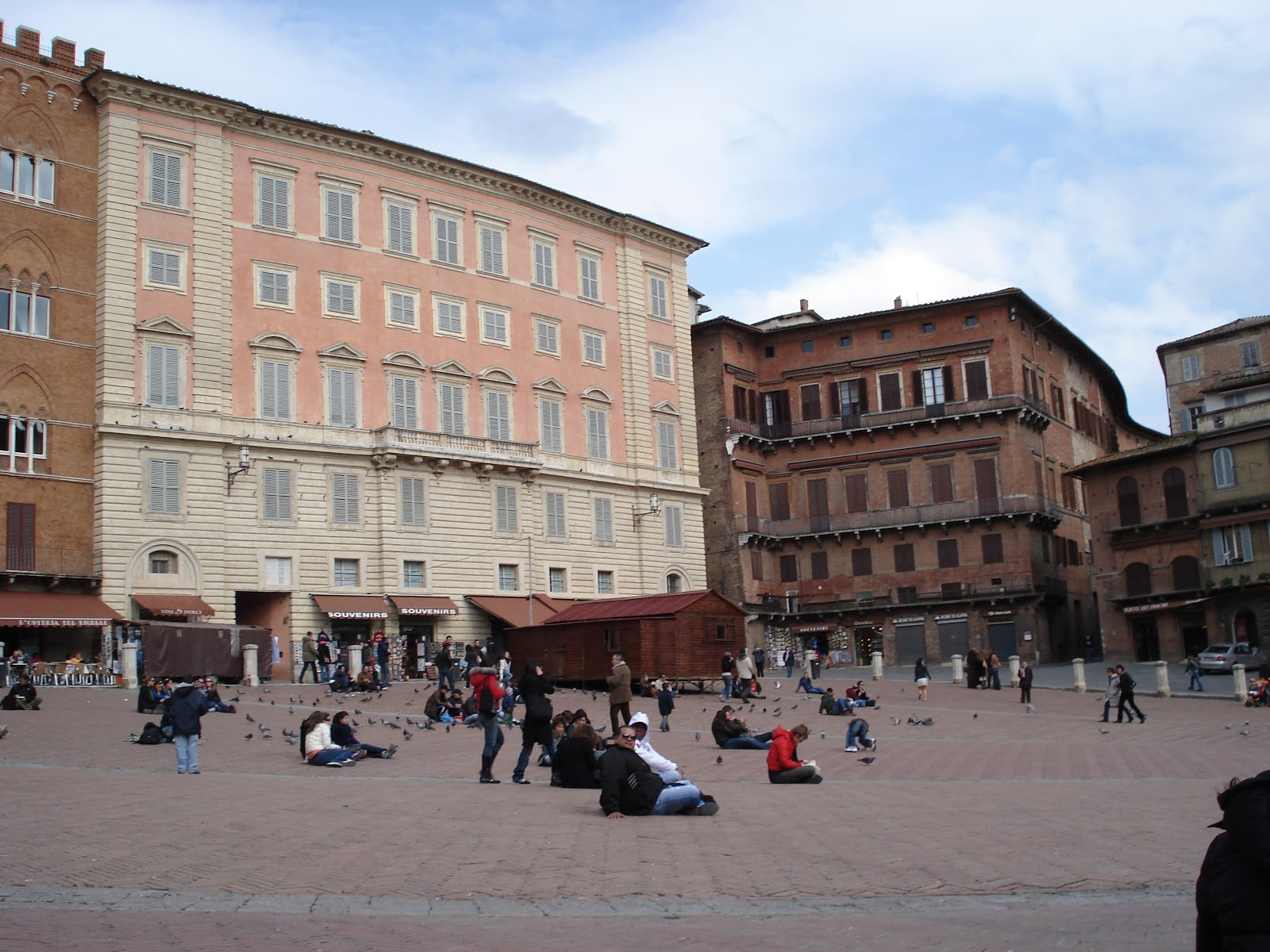 |
| Siena's main square |
Arezzo is also a town in Tuscany well worth visiting. It is the setting of the film La vita è bella by Roberto Benigni, and everywhere around the town there are signs that show which scene was shot there. If you are into poetry and have read Renaissance poets, you can visit the house where Petrarca was born in Arezzo.
 |
| Chianciano (photo by Elisa Correa) |


